



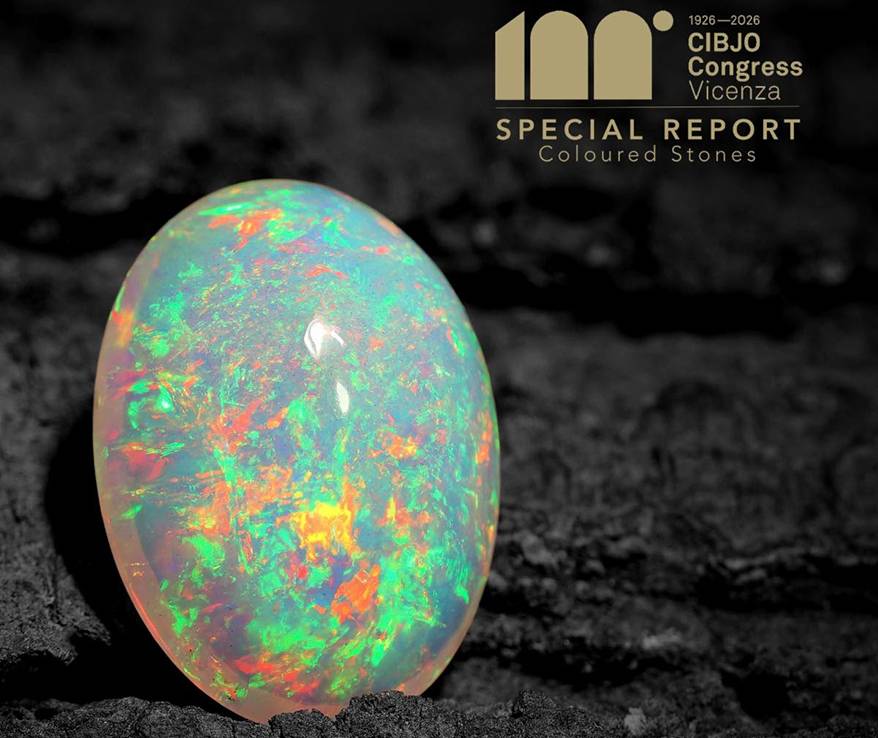

The CIBJO Coloured Stone Commission has released its fifth pre-Congress Special Report ahead of the 2026 CIBJO Congress, which will take place in Vicenza, Italy, from September 4.
The report, prepared by Commission chairman Charles Abouchar, focuses on the terminology used to describe coloured gemstones and the need for language that reduces the potential for misunderstanding in the marketplace.
“The ultimate goal remains protecting consumer confidence through the adoption of clear and descriptive language that transparently informs,” write Mr. Abouchar.
A key issue addressed in the report is the terminology used for synthetic gemstones. The Coloured Stone Commission has decided to remove the terms “laboratory grown” and “laboratory created” from the terminology permitted in the CIBJO Blue Book.
“Only the term ‘synthetic’ will be permitted from September 2026 onwards to describe ‘artificial products having essentially the same chemical composition, physical properties and structure as that of their naturally occurring counterparts.’” He writes. “In making this move it is hoped that the situation in the market will become clearer and the consumer will be properly informed.”
For jewellers, the change is relevant to product descriptions, sales materials and communication with customers, particularly where synthetic gemstones are offered alongside naturally occurring stones. The terminology also provides a consistent reference point for suppliers, laboratories and retailers.
New Guides and Valuation Work
The report also outlines the forthcoming introduction of a CIBJO Opal Guide and Jade/Fei Cui Guide. Both have been developed by expert committees over several years and will be available at no cost through the CIBJO website.
An ad hoc working group has also begun work on a Valuations Guide. According to the report, the guide will take into account different market conditions and customs in various parts of the world.
The development of these guides forms part of CIBJO’s broader work to establish terminology and guidance for the international jewelry industry. For businesses operating across different markets, such guidance can provide a common reference when describing and valuing materials.
Use of Colour Descriptors
Abouchar also addresses the use of colour descriptions that may appear in laboratory reports and commercial communications. He raises concerns about terms that can be interpreted as established standards when they may instead represent a laboratory’s own terminology or assessment.
“If a ruby is given a colour description ‘pigeon blood’ in a laboratory report, it will command a premium price in the market, the client, not aware that it is not an international standard, may pay an unjustified price. In addition, today the market is flooded with new names for colours every year, and I feel that this increase of names is only for the good of the laboratories and some clever dealers,” he writes.
The report suggests that where such descriptors are used, their status should be made clear rather than allowing them to be interpreted as internationally recognised classifications.
“Having spoken with many persons from the trade about this issue, I realise that most of them see the problem and understand the difficulty it represents for consumer protection. Most agree that we should discourage the usage of these terms, or if used they should be clearly presented on the reports as being the opinion of the laboratory,” he continues.
The terminology discussed in the report is expected to be considered alongside other industry standards at the CIBJO Congress in September.
