



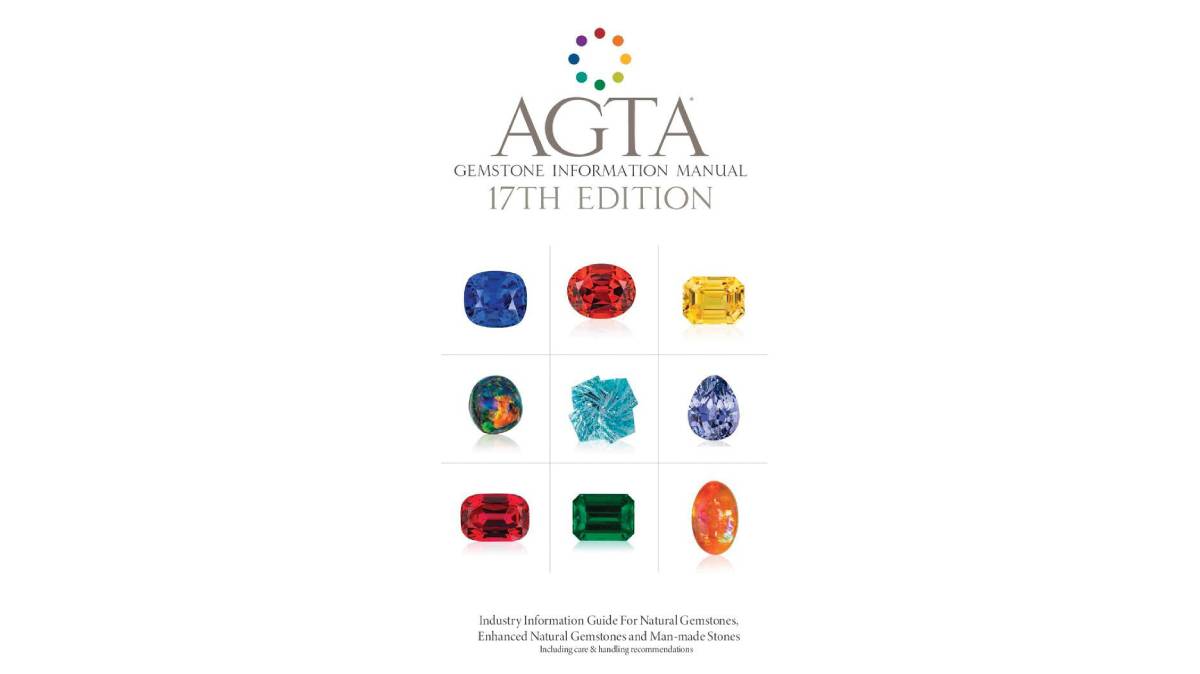

The American Gem Trade Association has released the 17th edition of its “Gemstone Information Manual” and revised its “Code of Ethics.” The changes introduce three enhancement symbols, update gemstone care guidance and establish terminology requirements for man-made gemstones.
New Enhancement Symbols
The manual adds three symbols to its “Specific Forms of Enhancement” section: ASBL for assembled stones, including doublets and triplets; HR for heating with residue; and W for waxing.
AGTA has also revised its Gemstone Information Chart, which now identifies irradiation (R) and heat (H) as common, stable treatments for pink morganite.
Updated guidance in the chart’s “Special Advice” section cautions against ultrasonic cleaning for certain gemstones, including jade and moonstone. Jewelers may need to reflect these changes in staff training, repair intake procedures and customer care instructions.
“I congratulate the Board of Directors and the AGTA Industry Rules Committee on completing the 17th edition of the ‘Gemstone Information Manual,’” said John W. Ford Sr., CEO of AGTA. “This trusted resource gives our members and the broader international gemstone industry practical, current guidance that supports responsible disclosure and ethical business practices.”
Disclosure Across the Supply Chain
The additional enhancement codes provide AGTA members with updated terminology for gemstone descriptions, invoices, identification documents and sales records.
“The Industry Rules Committee’s diligent work keeps the ‘Gemstone Information Manual’ current and useful,” AGTA President Bruce Bridges said. “These updates help AGTA members apply consistent disclosure and care standards throughout the supply chain while continuing AGTA’s longstanding role in setting standards the broader industry follows.”
Terminology for Man-Made Gemstones
AGTA has also revised its “Code of Ethics” following a policy approved by its board in June 2026.
Under the revised policy, members must use the word “synthetic” when describing a manufactured material that has essentially the same chemical composition, crystal structure and physical and optical properties as its natural counterpart. The term “lab-grown” cannot be used on its own to describe such a material.
The manual states that retail jewelers may use either “synthetic” or “man-made” alongside the gemstone name, such as “synthetic ruby.”
“Clear and consistent language is essential to consumer confidence,” Bridges said. “This policy gives AGTA members a straightforward standard for describing synthetic gemstones while reinforcing the association’s commitment to natural-colored gemstones.”
AGTA members may need to review product descriptions, labels, invoices, ecommerce listings and staff guidance to ensure that manufactured gemstones are described in accordance with the revised code.
